Marketing Automation Platform Comparison Methodology
The methodology Phave used to compare marketing automation functionality across legacy and newer vendors.
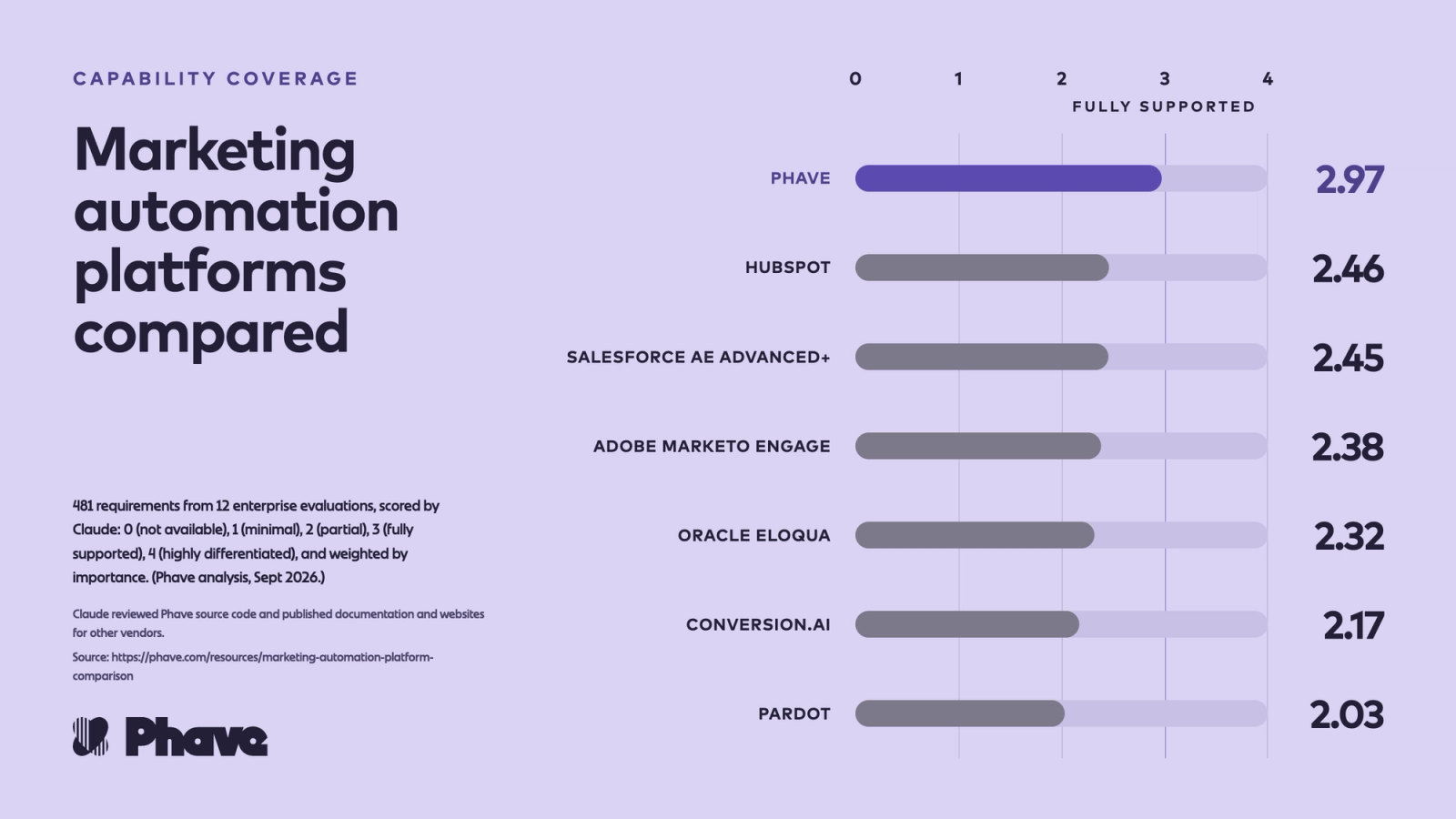
Phave scored 481 product requirements for itself and for each major platform, ran the scoring twice under different rules. Here's the methodology we used.
The result
Phave scored 2.97. Among the platforms it is built to replace, HubSpot scored 2.46, Salesforce Marketing Cloud Account Engagement Advanced+ 2.45, Adobe Marketo Engage 2.38, Oracle Eloqua 2.32, and Salesforce Account Engagement, the classic Pardot product, 2.03. Conversion.ai scored 2.17, making the assumption that functionality claimed on the website is fully available.
On the 214 requirements weighted 3 or 4, the ones that most affect which platform a buyer chooses, Phave scored 3.16 against 2.56 for the nearest platform.
Across 16 domains, Phave’s lead is especially high in:
- AI Assistant, Agents & Governance, where Phave scores 3.51 against 1.99 for the strongest incumbent
- Scoring, Fit & Predictive, 3.31 against 2.55
- Orchestration & AI Decisioning, 3.20 against 1.87.
The full domain table, with the strongest incumbent named in each, is available on request.
Where the requirements came from
Six actual enterprise RFPs, five industry RFP templates, and the Forrester Wave evaluation criteria for B2B revenue marketing platforms. Twelve sources.
Those sources yielded 535 rows. 481 carry weight and enter every average on this page. 36 are company and commercial questions, covering pricing, support model, roadmap, and references, which are tracked separately because they say nothing about the product. 18 are functionality outside of traditional marketing automation (like blogging software) and are excluded.
How the scoring worked
The scoring was done by Claude, reading Phave's own source code and each competitor's published documentation.
Each requirement was scored from 0 to 4 for every platform:
- 4 — fully supported and ahead of the field
- 3 — fully supported
- 2 — partial, or delivered through a partner
- 1 — minimal, or announced but not yet shipped
- 0 — absent
Announced, beta, and roadmap functionality scores 1 rather than 3. The rule applies to Phave the same way it applies to everyone else.
Each requirement also carries a weight for how much it affects which platform a buyer chooses: 4 for deal-shaping, 3 for important, 2 for standard, 1 for low, and 0 for the excluded rows. The 481 weighted requirements break down as 58 rows at weight 4, 156 at 3, 215 at 2, and 52 at 1, for a total weight of 1,182.
Every average on this page is the sum of score multiplied by weight, divided by 1,182. There is no normalization, no curve, and no rebalancing between categories.
Every row includes written evidence: what Phave ships, and for each competitor the specific documentation the score rests on. Every competitor score also carries a confidence flag. Confident means the capability is named in vendor documentation. Reasonable means it was inferred from adjacent documentation. Blind means no documentation was found.
The second scoring run
The 0 to 4 scale asks two questions in one number. Does the platform do the job, which is what 0 through 3 measures, and does it do the job better than everyone else, which is what a 4 means.
A 3 is a fact about a product, checkable against documentation or source code. A 4 is a claim about the whole category, and reasonable people can disagree about it. That makes it the softest part of the method, so we also removed it and published what was left. Every 4 becomes a 3. Same rows, same weights, same evidence, one fewer judgment.
Under the capped run, Phave scores 2.75 rather than 2.97. Salesforce Account Engagement Advanced+ scores 2.43, HubSpot 2.42, Marketo 2.34, Eloqua 2.30, Conversion.ai 2.16, and classic Pardot 2.02.
How Phave guarded against scoring itself generously
Phave was scored from its own source code, which is honest about its limits in a way no marketing page is. Competitors were scored from documentation, which is written to describe strengths. Left uncorrected, that asymmetry skews in both directions at once, and most of this method exists to correct it.
Competitor scoring ran as separate passes, one platform and one domain at a time, so no pass could see a running total or steer toward one.
A vendor's marketing page is a lead, not evidence. Where a claim is detailed, undocumented, and not contradicted by that vendor's own documentation, it scores 2.5 and is flagged. Where a vendor's documentation contradicts its marketing page, the documentation wins. Where this fork produces two possible figures for a platform, the number published here is the one that favors them. Conversion.ai appears above at 2.17 on that basis rather than at 2.01.
Corrections are logged rather than quietly rewritten. Conversion.ai's lead-scoring page described a mechanism their documentation had named differently, which exposed an inconsistency in our own scoring. Two rows moved up.
A limitation on Inflection.io’s scores
Every other platform above was scored from product documentation deep enough to support row-level evidence. Conversion.ai, for example, was scored across 185 documentation pages.
Inflection.io publishes a help centre rather than product documentation at that depth, so the same 0 to 4 scale rests on materially thinner material and the resulting number is not comparable to the others.
The analysis places Inflection below every platform in the tables.
Where incumbents score higher than Phave
Security, Privacy & Compliance, where the strongest incumbent scores 2.87 against Phave's 2.67. Data residency across multiple regions is the clearest single example.
Integrations & API, 2.67 against 2.54. A platform launched in 2026 has fewer vendor-built integrations than one that has been collecting them for a decade and a half.
What was excluded
Eighteen requirements were weighted zero and left out of every average, because they are outside traditional marketing automation: content management and blogging, SEO tooling, social publishing and listening, video hosting, and in-platform image editing among them.
HubSpot scored well above Phave on all eighteen.
The 36 commercial rows are excluded for a different reason. Pricing, support model, roadmap, and references matter to a buying decision, but they measure a company rather than a product, and mixing them into a product score makes both harder to read.
How current this is
Scored in September 2026 against a dated Phave build and dated vendor documentation. Platforms change, and a score is a reading at a point in time rather than a permanent fact.
Any vendor can correct a row with documentation. Because the evidence column names what each score rests on, a correction is a specific argument rather than a complaint.
The full assessment
The row-level assessment, all 481 requirements with scores, weights, evidence, and confidence flags for every platform, is available under NDA on request. Contact us.